
Infantino’s Fifa Future Is Crumbling and the Scottish FA Just Kicked Another Stone Loose


Real Madrid loanee scores first career hat-trick in stunning Lyon debut
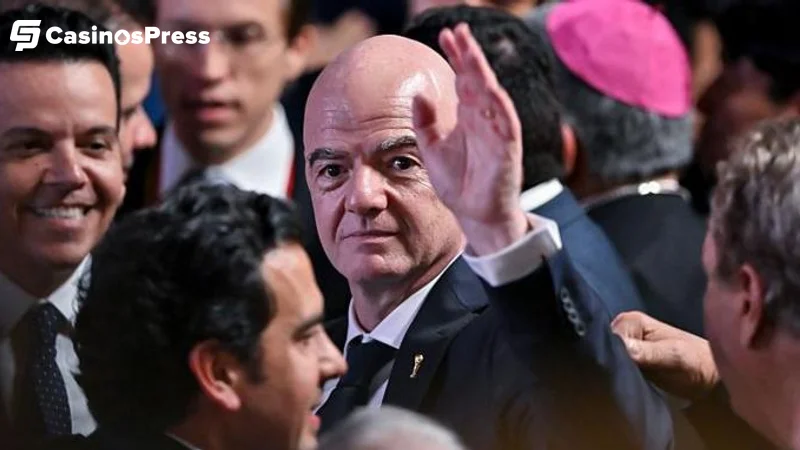
The walls are closing in on Gianni Infantino. The Scottish FA's decision to publicly withdraw support for the Fifa president is the latest blow in what is fast becoming a full-scale political crisis at the top of world football. And for anyone paying attention to how this plays out, the implications stretch far beyond one election.
The SFA Move Is Bigger Than It Looks
On the surface, Scotland's football association pulling its vote might not seem like a seismic event. The SFA is not a football superpower. But context matters here.
This announcement came directly from chief executive Ian Maxwell, clearly aligning the SFA with Uefa's bloc of 55 member associations. That's 55 nations moving as one voice against the Fifa president. England, Wales, the Republic of Ireland and now Scotland have all publicly declared they will not vote for Infantino when elections come around in March 2027. The British and Irish football associations are not known for making loud political statements. When all four of them are on the same side, it tells you something has gone very wrong for Infantino.
What triggered this? The attempt to create Fifa Forward Enterprise, a private company that would have handed commercial and ticketing rights for Fifa competitions, including the World Cup, to a structure with 21% sold off to private investors. Uefa led the backlash. The plan was abandoned, but the damage to trust was already done.
Three Terms or Four? The Eligibility Question Nobody Can Ignore
Beyond the political fallout, there is a genuine legal argument that Infantino may not even be eligible to stand again. Fifa's own statutes cap the presidency at three terms of four years, meaning a maximum of 12 years in charge. If Infantino wins in 2027 and serves until 2031, that's 15 years.
His defence rests on a decision made in 2022 that discounted his first partial term, from 2016 to 2019, on the basis it was not a full four-year cycle. He took over mid-term from the disgraced Sepp Blatter. A Fifa governance committee accepted that argument at the time.
But critics say the logic is flawed and the process was opaque. There's no published written justification for the decision. The exemption was granted without Fifa Congress being involved. And the argument that a 15-year presidency is consistent with the spirit of a three-term limit is one that most people would struggle to make with a straight face.
This is not just procedural noise. If the eligibility question ends up in front of an independent legal body, Infantino's candidacy could be ruled out entirely before a single vote is cast.
A Governing Body Tearing Itself Apart
What makes this genuinely difficult to call is that football is split right down the middle. Uefa, Concacaf and the Asian Football Confederation have openly questioned Infantino's leadership. The confederations of Africa, South America and Oceania have backed him. Even within those blocs there is fracture, with New Zealand breaking from Oceania and eight Asian nations splitting from the AFC position to support Infantino.
We're looking at a situation where the Fifa Council itself appears evenly divided. That raises a serious question: even if Infantino wins, can he actually govern? A president who scrapes through a contested election with half the football world against him is not in a strong position to run the sport.
The first real test comes in just over three weeks, when the Fifa Under-20 Women's World Cup kicks off in Poland. Five European nations, including England, are participating. Uefa has threatened a boycott of Fifa competitions. Whether that threat holds when actual games are on the line will tell us a great deal about how serious these confederations really are.
Our Read on Where This Ends
Infantino is a survivor. He has navigated serious pressure before and he understands Fifa's internal politics better than almost anyone. The confederations backing him, particularly from Africa, carry a lot of votes among the 211 member associations.
But this feels different. The FFE controversy gave his opponents a concrete, specific grievance that is easy to explain to any member association. The eligibility argument gives them a potential legal route to remove him from the ballot entirely. And the fact that no rival candidate has yet emerged before the November deadline either means this ends in a surprise withdrawal from Infantino, or a messy election with very little clarity on who actually wins.
For football, the uncertainty itself is the problem. A sport that depends on global trust and commercial confidence cannot afford a governing body that looks like it's fighting a civil war.
Editorial Note: Marcus Osei
Senior football writer and tactical analyst with 12+ years covering the Premier League, Champions League, and world football. Born in Accra, raised between London and Kuala Lumpur.